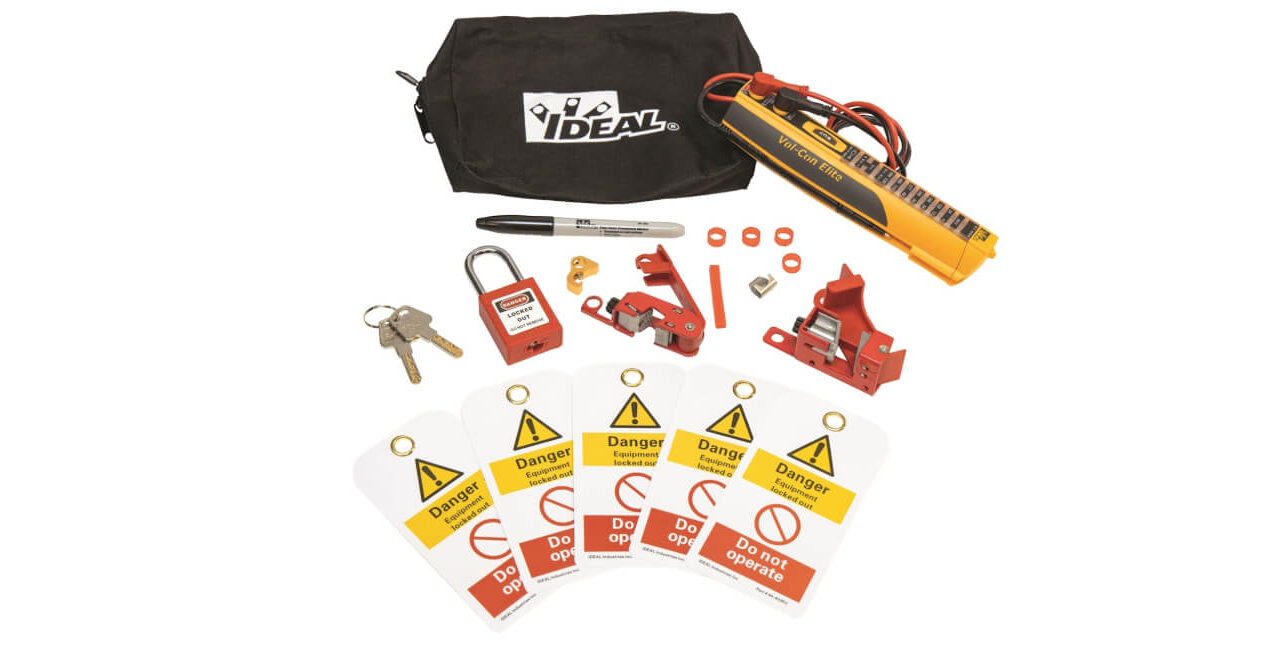
Ideal Industries has launched a Student Safe Isolation Kit, designed especially for trainee heating engineers.
The new Student Safe Isolation Kit from Ideal Industries includes a Vol-Con® Digital Voltage Tester, which tests for both AC and DV voltage.
It provides a visual and audible alert for continuity and non-contact voltage and features low impedance to eliminate ghost voltages.
Costing £58, the kit also includes a medium circuit breaker lockout kit, a universal MCB lockout device, a safety padlock, re-usable lockout tags and a marker pen, all contained in a handy pouch.
Ideal Industries said after speaking with further education providers it was clear that trainee heating engineers are not routinely trained in electrical connections, so are not being taught safe isolation best practice or provided with safe isolation equipment on site.
Brett Smyth, General Manager of Ideal Industries UK and EMEA said: “Poor safety behaviours around isolations is a potential hazard for heating engineers. Electrical connections for gas heating systems generally make up 10-15% of the work involved so it’s important that heating engineers know how to protect themselves from the risk of electrical distribution networks being inadvertently switched back to live while they are still working.
“We want to help reduce that risk by highlighting safety best practice and have been working with training providers to look at how we can help drive a cultural shift. Designing a Safe Isolation Kit that has everything a trainee heating engineer needs and ensuring it’s available at an accessible price is a significant milestone in this regard.”
The launch of the new kit has been welcomed by training providers. Adrian Davey, Trainer at Steve Willis Training Centres, said: “It’s not unusual for the electrical to be inadvertently switched back to live, which is a significant danger for any heating engineer working on an installation.
“The only way to protect operatives on site is to test for residual current, lock out the isolation and tag it. It may only be a relatively small element of the installation but it’s important that anyone training in the heating engineering sector prioritises those good habits. Making a safe isolation kit specifically designed for and accessible to students is a very positive step in this process.”