

Applications open for HIP LOY & FSC 2027
Applications are now open for 2027 – get involved in HIP Learner of the Year & HIP Female Skills Competition today!
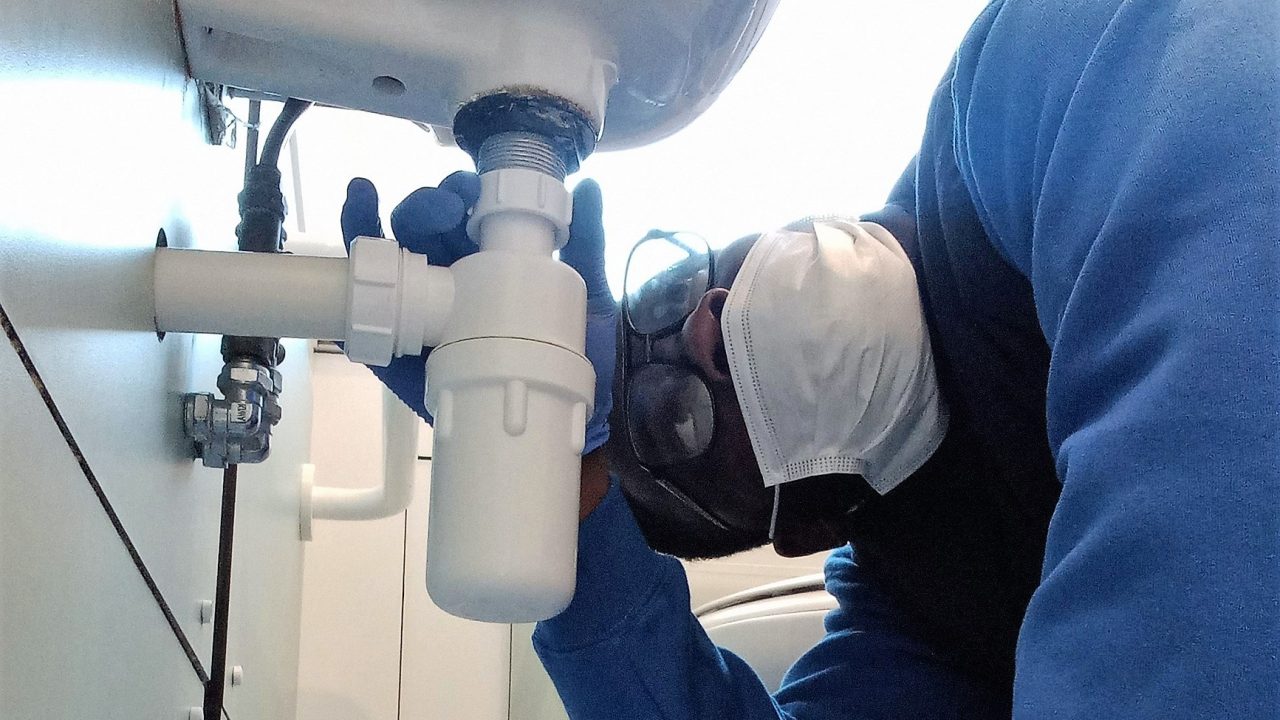
By his own admission, Harold Impraim was lost after graduating from university.
Despite gaining a business studies degree from the University of Bedfordshire, he found himself stuck working in retail and at a cinema in Enfield.
Five years later he decided to retrain as a plumber and today, Harold, 37, runs his own business, Higreen Plumbing and Handyman Services in Tottenham, north London.
“I wasn’t enjoying work and felt like something was missing, and I wanted to be in control of my future,” said Harold.
“I was trying to find my feet and what I was good at. People that knew me said, ‘You’re quite practical, why don’t you try construction and do some labouring so you can see all the tradesmen, ask them some questions and see what suits you?’
“I knew plumbing was a trade that would always give you work, the money was good, and I could potentially start my own company.”
“I started watching YouTube videos on plumbing maintenance and would look around the house and see what I could do instead of calling someone to do it.”
After completing a Plumbing Level 1 Diploma at the College of Haringey, Enfield and North East London (CONEL), Over the next two years Harold went on to complete a Plumbing Level 2 Apprenticeship with Capital City College Training (CCCT).
During this time he received an Excellence Award from CONEL.
“I was really excited about plumbing. It didn’t bother me that I was having to go back to college. I knew this is what I wanted to do and what I needed to do to get there,” said Harold.
“I knew I would get hands on experience and learn on the job. I didn’t want to come out with just a certificate. I also didn’t have the money to do a full-time course but I knew I would get paid on an apprenticeship.
During his apprenticeship, Harold worked on many large projects and developments including Tottenham Hotspur Stadium, South Quay Plaza building at Canary Wharf and the Elizabeth Line.
He said: “When I walk past some of those places with my friends and tell them I played a part in building them, it gives me a sense of pride that makes me feel good.
“I learnt a lot on my apprenticeship about problem solving, measuring, cutting and fusing pipes, about different systems and heating units, lagging and keeping pipes at the right temperature, and how to read blueprints and schematics.”
“I enjoy hands-on practical things, do this and this is the result, and explaining what I have done and the process behind it. I felt a lot of satisfaction knowing I could do this.”
During his apprenticeship Harold also learnt some carpentry to help him build bath frames along with some electrical and tiling skills.
He said: “At college we could practice and correct mistakes with the help of our teachers. They would share their experience, but it was also down to us to ask questions and show willingness to achieve our goals.”
Harold has no regrets about doing his degree as it has helped him with running his business but in hindsight feels he should have chosen an apprenticeship sooner.
He said: “University was a good experience but if I was to start it again, I wouldn’t have gone and would have just done an apprenticeship or an internship for a job I wanted to do.
“I would do an apprenticeship for any job because it gives you experience of what it’s like working it in the real world. In the time it took to do my degree, I could have done my apprenticeship training and have been working in trade.”
Harold was attracted to the varied work a career in plumbing offered and in his own words “it’s better than selling tickets and popcorn at a cinema.”
“It can be challenging and tiring sometimes but it’s a very fulfilling career. Not just the money, but the kind things people say when you’ve helped them on site or at their home,” he said.
“I also like the professional status that comes with it. When people ask me what I do for a living, I’m proud to say I’m a plumber.”
If your company is interested in running apprenticeships, call CCCT on 0207 391 6400 or email employer@capitalcct.ac.uk
For more information visit www.capitalcct.ac.uk
The apprenticeship levy was introduced in April 2017 to encourage employer to invest in high quality apprenticeship training.
All UK employers with a total employee pay bill of over £3 million a year must pay the levy whether they employ any apprentices or not.
The levy rate is set at 0.5% of the employer’s pay bill.
Employers get a £15,000 fixed annual allowance to offset against the levy payment.
The levy is collected by HMRC and accessed through the Digital Apprenticeship Service to pay for apprenticeship training within a two-year period.
The money can be used to train existing employees or new apprentices.
Find more information at: www.gov.uk/guidance/how-to-take-on-an-apprentice
Applications are now open for 2027 – get involved in HIP Learner of the Year & HIP Female Skills Competition today!

Giving and Taking Feedback Like a Pro: Learn how to give constructive feedback, take advice on board and build the skills to succeed in your career!

Get Involved. See What You Can Achieve: Discover how entering HIP competitions can boost your confidence, challenge yourself and help you realise your potential!

Carhartt women’s steel pants have been designed around how women actually move and work on site rather than simply resizing men’s.
Registered Plumbers: 91% of UK homeowners believe installers should be qualified, vetted and on an official register.

We are delighted to announce the winner of the HIP Female Skills 2026 – congratulations to Bronwen Evans from Cardiff and Vale College!