

Wilo’s Sustainability Commitments to Replace Inefficient Pumps.
Wilo has set out its plans to achieve net zero carbon after releasing its latest Sustainability Report detailing its business-wide sustainability commitments.

Earlier this year, cross-industry group Hydrogen Strategy Now said its members were ready to pump £1.5bn into the UK hydrogen economy. That figure has now doubled as more businesses line up plans for hydrogen projects across the UK.
Now bosses from leading businesses have come together to call on the Prime Minister to pave the way for a British hydrogen economy in his long-awaited energy strategy as they vowed to heavily invest in hydrogen technologies.
Members of Hydrogen Strategy Now, which combined employs around 100,000 people and has a value of £100bn in the UK, said their shovel-ready projects would create thousands of jobs across the country, helping to kick start a post-COVID green recovery.
But its members have warned that unless the sector receives loud and clear backing from the Government, the UK risks being left behind the rest of the globe.
The Hydrogen Strategy Now collective wants to see a clear, strategic plan to help unlock significant private funding in hydrogen technologies and manufacturing across the country, driving growth and generating hundreds of thousands of green jobs.
They believe a UK-wide hydrogen economy will:
A letter from the group to the Chancellor earlier this year stated:
“As you look to design a post-COVID recovery, we encourage you to focus on creating high-skilled, green jobs, in sectors that will be critical to the future economy, such as low-carbon energy, transport and heavy industry.
“These measures would be wholly complementary to the Government’s leveling-up agenda and long-term decarbonisation goals. For example, the Committee for Climate Change has made it clear that the UK will not meet its Net Zero targets without significant investment in the hydrogen economy.
“The global hydrogen economy is estimated to be worth $2.5 trillion by 2050, supporting 30 million jobs. Other nations, such as Australia, Japan, South Korea, Canada, and China have already set ambitious strategies for growing their hydrogen economies.
“Just last week, Germany joined this list with their own €9 billion hydrogen strategy. The European Commission is also creating an EU hydrogen strategy, which includes plans for multi-billion euro investment in hydrogen projects, and schemes to boost sales of hydrogen electric vehicles.
“It is now clear that hydrogen is going to play an essential role in the world’s future, low-carbon economy. The increasingly bold steps being taken by other nations underlines the need for the UK to bring forward urgent measures to establish a hydrogen strategy and unlock investment and innovation. We should not risk falling behind other nations in developing our hydrogen industry.”
Wilo has set out its plans to achieve net zero carbon after releasing its latest Sustainability Report detailing its business-wide sustainability commitments.
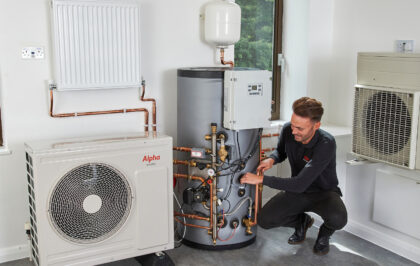
Dan Wilden, renewable product manager at Alpha, explains why we don’t need to wait for hydrogen and why now is the time to install a hybrid system to cut emissions and help to reduce bills.

Continued investment in training essential to deliver on net zero ambitions
The transition to low carbon heating will be driven by the training industry and support for providers must be front and centre of the UK’s decarbonisation strategy if we are to accelerate the rollout of low carbon technologies and achieve our net zero targets.

National Apprenticeship Week: New generation of professionals will be crucial to a net zero future, says Baxi MD

With the UK urging homeowners to be more environmentally conscious, Alpha has launched a brand-new hybrid heating system, E-Tec Hybrid.
Rinnai’s Chris Goggin examines American interest and usage of hydrogen as a major contributor towards future decarbonizing of domestic energy options.