

26.5% of UK Residents Don’t Have Carbon Monoxide Alarms Installed
More than a quarter of UK residents don’t have carbon monoxide detectors installed in their current homes, according to new research.

As part of the 2016 Paris Agreement, the world’s largest economies agreed to keep global warming under 2°C. In response, the Committee on Climate Change (CCC) advised the UK government to aim to become net zero on greenhouses gases by the year 2050.
Having net-zero emissions essentially means achieving a state of balance by removing any human-caused greenhouse gases from the atmosphere through a process called carbon removal.

A fundamental part of achieving net-zero is to reduce the emissions to as close to zero as possible. And it is for this reason the UK government are currently exploring many potential ways to cut down on emissions and where necessary creating new policies to implement them.
With heating currently accounting for one-third of UK carbon emissions, it is no surprise that it is receiving a lot of attention and scrutiny as the government looks for new ways to drive efficiencies.
In early 2019, Chancellor Philip Hammond sent shockwaves through the industry when he announced plans to ban gas heating in all new build properties by 2025.
There is no official law banning gas boilers at present, but there are plans to establish a new set of rules in a new document known as the ‘Future Homes Standard’ – a paper that is predicted to set out new guidelines that aim to change Parts L (conservation of fuel and power) and F (ventilation) of the Building Regulations.
If passed into law this will mean new homes will be required to emit 75-80% less Carbon Dioxide (CO2) emissions than those built to current regulations.
A major part of the government achieving its plans is to improve the energy efficiency of all current UK properties, in hopes that demand for heating will be reduced – and therefore emissions.
In 2020, the government made changes to building regulations with regards to the energy efficiency regulations, requiring new builds to be more efficient than previous code demanded.
Just last month, the government announced the Green Homes Grant scheme which aims to make 650,000 homes more energy efficient.
It is clear that the government are taking their pledge for a greener future seriously, with new energy efficiency regulations, yet to date, no ban on gas boilers exists in law. But what would it mean if replacing your boiler was banned?
If the plans to ban gas heating are implemented, what are the viable alternatives to replacing conventional gas boilers?
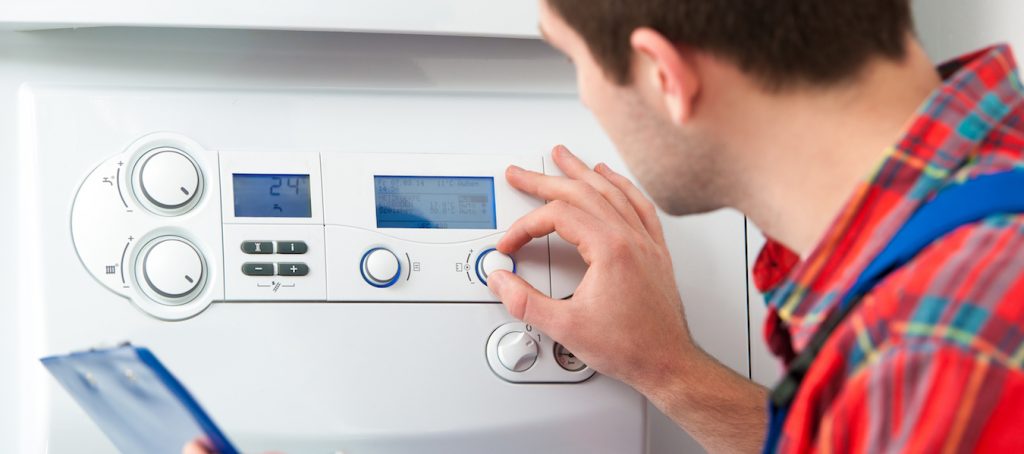
It is clear that governments around the world are getting more serious and the UK government’s ‘Future Homes Standard’ documentation provides some important clues as to where we might be heading.
The guiding document determines that more homes will adopt heat pumps, heat networks and to a lesser degree direct electrical heating.
So, what are these new methods of home heating?
The CCC has indicated that heat networks are going to need to account for 18% of UK heating by 2050 if the net-zero goal is to be achieved. So, it is certainly something we can expect to see more of since it currently only accounts for 2%.
As the name implies, heat networks provide heat to homes using a network of pipes that come from a central location transporting hot water. It also means homes can avoid individual heaters and boilers and so it has been termed ‘central heating for cities’.
There are many potential heat sources for the central location including waste disposal plants, power stations and biomass facilities.
The heat is then transported into the home via a heat exchanger, which is about the same size as a traditional boiler. The unit also has many of the same controls as a regular boiler, allowing the hot water and temperature to be controlled as homeowners would expect.
Just like your household refrigerator, a heat pump works by transferring heat from one place to another. They operate using a chemical component known as a refrigerant, this controls the movement of heat via two principles – condensation and evaporation.
Essentially, they work by absorbing heat from the outside in the colder months, while in the warmer months emit excess heat to the outside environment.
Currently, air-source heat pumps are relatively expensive, but once installed they are extremely energy efficient.
With the government and homeowners set to take energy efficiency much more seriously, overall heat wastage is expected to decrease. Combine that with the trend for adopting greener, gas-free heating appliances set to continue, greenhouse gas production should continue a steady decline.
But what about those cold chilly nights when you need some supplemental heating?
According to the “Future Homes Standard” documentation, it seems electrical heating will be the go-to option.
Although electric heating as traditionally been an expensive option and one tied to the burning of fossil fuels, it has not been taken seriously as a potential part of the solution.
Yet with the adoption of greener methods of electricity generation, it looks like it will become the preferred choice for zonal and supplemental heating.
With global and UK net-zero targets to be met, it is clear that changes to the heating industry are set to continue over the coming decades.
As an industry, we need to keep up to date with these changes and adapt both our knowledge and skillset as the demand for new technologies grow and the more traditional variety begins to wane.
More than a quarter of UK residents don’t have carbon monoxide detectors installed in their current homes, according to new research.
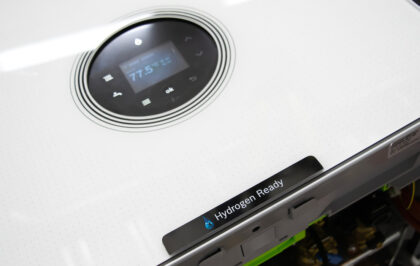
Worcester Bosch has unveiled a prototype boiler that runs on 100% hydrogen gas and fits into the same footprint as a current natural gas boiler.